
Shifting from Harm to Harmony

When Is It Time to Bring in a Mediator? (Hint: Earlier Than You Think)

Conflict has erupted. A competent mediator is vital.

“If you’re hearing about a conflict, it’s probably already causing problems.”

Leaders often pause at that moment. They’ve caught wind of tension—maybe a complaint, a strained meeting, a subtle shift in tone—but they’re unsure what to do next. Is this just normal workplace friction? Will it resolve on its own? Or will bringing in a mediator escalate things further?

It’s a reasonable question. No one wants to overreact. But in practice, the hesitation is often more costly than the intervention.

Because here’s the reality: if a conflict were going to resolve itself, you likely wouldn’t be thinking about a mediator at all.

By the time conflict becomes visible, it has usually been building quietly beneath the surface—through missed communication, unspoken frustrations, and small moments of workplace incivility that accumulate over time. Research from Society for Human Resource Management has consistently shown that workplace incivility—those low-level behaviors like ignoring emails, interrupting, dismissing input, or withholding information—can significantly erode trust, engagement, and productivity. Left unaddressed, these patterns don’t stay small. They compound.

Conflict can intensify over time.

I saw this play out clearly about a year ago, when I was contacted by a major international organization. They needed support mediating a conflict between senior-level leaders in a high-stakes environment—one where decisions had real-world consequences and, quite literally, lives on the line.

The situation was already complex. Communication had broken down. Trust was frayed. Teams were beginning to feel the ripple effects.

To their credit, leadership recognized the need for support. They reached out and we began coordinating a mediation process. It took a week or two to align schedules, prepare participants, and set the stage.

And then, just two days before the mediation was set to begin, a group of managers walked out.

What had been a contained leadership conflict suddenly became an organizational crisis.

When we stepped in, we weren’t just addressing the original dispute. My partner and I were walking into what I can only describe as crisis-upon-conflict: fractured leadership, destabilized teams, and an urgent need for guidance on how to respond to a sudden loss of workforce capacity.

The cost of waiting had multiplied.

Had we been brought in even a month earlier—when the tension first began affecting leadership meetings, when communication first started to break down, when decisions became slower and more strained—the trajectory could have been entirely different. The conflict would still have required attention, but it likely would not have escalated into a full-scale disruption.

This is the pattern I see again and again.

Leaders often wait for certainty before acting. They want clear evidence that something is “serious enough” to warrant outside support. But conflict doesn’t announce itself that way. It shows up in quieter signals: hesitation in meetings, delayed responses, repeated misunderstandings, or growing frustration between key players.

These are not minor issues. They are early indicators.

Early intervention is not escalation—it is prevention.

One of the misconceptions about mediation is that it is a last resort, something you bring in when everything else has failed. But the most effective mediations often happen long before that point. They create space to address tension while relationships are still intact enough to repair, before positions harden and before teams begin to fracture.

This is where the 3D Harmony approach – Dignity, Dialogue, and Discovery – becomes especially valuable.

Instead of jumping straight to solutions or forcing premature agreement, 3D Harmony focuses first on restoring dignity in the interaction. That means ensuring that all parties feel heard, respected, and able to participate without fear of being dismissed or overpowered. In environments where incivility has crept in, this alone can begin to shift the tone.

From there, the focus moves to dialogue—equipping individuals with the tools to actually communicate in a way that is constructive rather than reactive. Many workplace conflicts persist not because the issues are unsolvable, but because the communication patterns around them are ineffective. When those patterns change, movement becomes possible.

Finally, discovery allows teams and leaders to uncover what is really driving the conflict beneath the surface. Often, what appears to be a disagreement about strategy or process is rooted in unmet needs, unclear expectations, or misaligned assumptions. Without creating space for that deeper understanding, organizations risk addressing symptoms rather than causes.

In the case of the organization I mentioned, we eventually worked through both the immediate crisis and the underlying conflict. But the process was more complex, more urgent, and more costly than it needed to be.

The lesson is straightforward, even if it’s not always easy to act on: timing matters.

If conflict is beginning to affect leadership, disrupt communication, or slow down decision-making, that is the moment to act. Not after a breakdown. Not after people disengage or leave. Not after the problem becomes too large to ignore.

Because time is not neutral in conflict.

Time is fuel.

And the earlier you bring in the right support, the more likely you are to transform that energy into something productive—before it turns into something you have to contain.

Facebook
Twitter
LinkedIn
Email
Pinterest

How Can We Help You Today?

How can we help you today?

Subscribe to Our Newsletter

Get quick tips, thoughts to ponder, links to our upcoming courses, and more!

Free Consultation

Drop us a line for a FREE 15 minute consultation to help you handle your conflict or challenge!

Fill out the form below for a copy of our White Paper on:

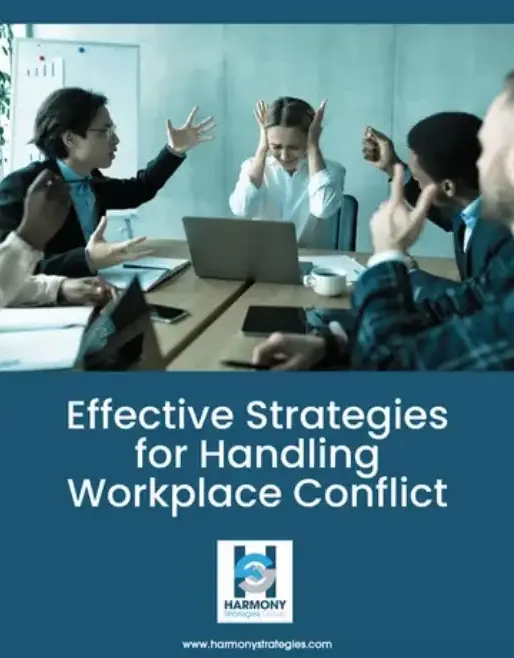
Effective Strategies For Handling Workplace Conflict

Melody Wang

Melody Wang is a Conflict Consultant with the Harmony Strategies Group and CEO of Wang Mediation, which she founded upon graduation from the University of Southern California, Gould School of Law with an MA in Alternative Dispute Resolution. Melody is a panel mediator for the New York City Family Court and serves on the Board of Directors at the Association for Conflict Resolution, Greater New York (ACR-GNY). Prior to moving to New York, Melody was an experienced civil and community mediator in Los Angeles, California, working closely with non-profits, small claim courts and the California federal court. She also led selected trainings and workshops on dispute resolution within the Asian-American community in California.  Melody has lived in the U.S., Taiwan, China and Singapore, is fluent in English, Mandarin Chinese and Taiwanese, and especially enjoys engaging in international relations and cross-cultural conflict systems.

Dara Rossi

Dara Rossi, Ph.D. is a Conflict & Strategy Consultant with the Harmony Strategies Group. She has more than 20 years of experience in the field of education and has worked with students from kindergarten through the university graduate level. Additionally, she has facilitated professional development for educators and administrators across all points on the education continuum. After10 years of service in the Department of Teaching and Learning Southern Methodist University, she launched her coaching and consulting business while continuing to serve as an adjunct professor. She holds a PhD in Curriculum and Instruction, an MBA, an MA in Dispute Resolution, and an MAT in Education, and BS in Human Development.

Isar Mahanian

Isar Mahanian, M.Sc. is a Conflict & Strategy Consultant with the Harmony Strategies Group. She is an active mediator who coaches new mediators in the program in which she serves. Isar has worked at a fast-paced technology start-up as the Head of Human Resources, leading senior executives to mitigate and resolve workplace conflicts and creating system level improvements for employees within the company. She holds a Master’s of Science degree in Negotiation and Conflict Resolution from Columbia University. 

Kimberly Jackson Davidson

Kimberly Jackson Davidson is currently the University Ombudsperson at George Mason University and member of the Harmony Strategies Group. She spent two decades at Oberlin College in Ohio, holding positions in the Office of the Dean of Students and as Visiting Lecturer in African American Studies. During her final five and a half years there, she served all campus constituencies as Ombudsperson and Director of the Yeworkwha Belachew Center for Dialogue (YBCD). Davidson is active within the International Ombuds Association (IOA), the California Caucus of College and University Ombuds (CCCUO), and the Ombuds Section of the Association for Conflict Resolution (ACR). She earned a B.A. in English Literature from Spelman College in 1986 and an M.A. from the University of Wisconsin-Madison in African Literature in 1991.

Hector Escalante

Hector Escalante is an experienced Ombuds and learning and development professional with over seven years of ombuds experience and over twenty years of experience developing and teaching course offerings which promote inclusion, healthy communication, and conflict resolution. He is the Director of the Ombuds Office at the University of California, Merced, having served many years as the organizational ombuds at the University of the Pacific. He is an ombuds partner with Harmony Strategies Group, and a consulting ombuds for Earthjustice and Union of Concerned Scientists.  Hector holds two master’s degrees and a doctorate in education. He is a United States Marine Corps veteran, a husband and father to four children. Hector’s passions include treating all with fairness, equity, dignity, and compassion and good food. 

Stuart Baker

Stuart Baker is a Conflict and Strategy Consultant with the Harmony Strategies Group. He combines decades of professional experience in the construction industry as a general contractor and carpenter and blends his project management with mediation, facilitation and workshop presentations on dispute resolution. Based on his unique combination of skills and expertise, Stuart authored the book Conscious Cooperation, a practical guide on strategic planning and negotiation for the construction and homebuilding communities. Stuart brings a broad sensitivity to his consulting work and has mediated disputes large and small – from international corporate disputes to family conflicts. Likewise, Stuart coaches and consults individuals facing business, community, religious, or family challenges. He enjoys helping people overcome obstacles and deepen their harmony and connection with others.
 

Kira Nurieli

Kira Nurieli is the CEO of the Harmony Strategies Group and is an expert mediator, conflict coach, trainer/facilitator, consultant, and restorative practices facilitator. She has spent upwards of twenty years helping clients handle conflict and improve communication strategies and has presented at numerous conferences and symposia as a subject matter expert. She holds a Master’s degree in Organizational Psychology from Columbia University and a Bachelor’s degree in Comparative Performance from Barnard College. She especially enjoys helping individuals, teams, and lay-leaders become more impactful and empowered in their work and is honored to work alongside her esteemed colleagues with the Harmony Strategies Group.

Book Now

Glad to help you out – please fill in the form below, so we can get started!

Contact Us

Drop us a line for a FREE 15 minute consultation to help you handle your conflict or challenge!

Book a Workshop

Glad to help you out – please fill in the form below, so we can get started!